
Introduction
Have you ever wondered why the days of the week are named the way they are? Well, each day of the week has a unique origin that dates back to ancient times. In this article, we will explore the fascinating history behind the names of the days of the week.
Sunday

The name "Sunday" comes from the Old English word "Sunandæg," which means "day of the sun." This name was given to the first day of the week because it was believed to be the day that the sun was created in many ancient cultures. In addition, Sunday was also considered a day of rest in many cultures, including Christianity and Judaism.
Monday

The name "Monday" comes from the Old English word "Monandæg," which means "day of the moon." This name was given to the second day of the week because it was believed to be the day that the moon was created in many ancient cultures. In addition, Monday was also considered a day of rest in many cultures, including Islam.
Tuesday

The name "Tuesday" comes from the Old English word "Tiwesdæg," which means "Tiw's day." Tiw was a Norse god of war and justice, and this day was dedicated to him. In Latin, Tuesday is called "Dies Martis," which means "day of Mars," the Roman god of war.
Wednesday

The name "Wednesday" comes from the Old English word "Wōdnesdæg," which means "Woden's day." Woden was a Norse god associated with wisdom, magic, and poetry. In Latin, Wednesday is called "Dies Mercurii," which means "day of Mercury," the Roman god of commerce and communication.
Thursday

The name "Thursday" comes from the Old English word "Þunresdæg," which means "Thor's day." Thor was a Norse god associated with thunder, lightning, and storms. In Latin, Thursday is called "Dies Iovis," which means "day of Jupiter," the Roman god of sky and thunder.
Friday
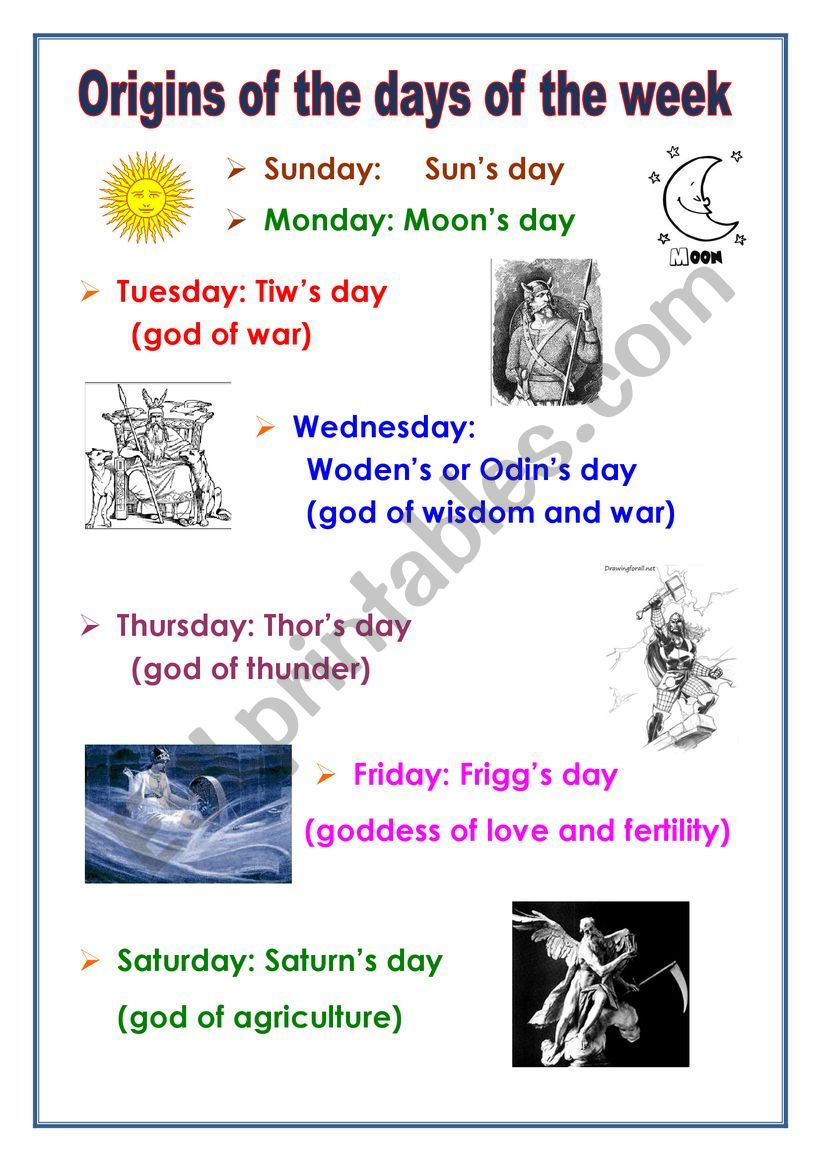
The name "Friday" comes from the Old English word "Frīgedæg," which means "Frigg's day." Frigg was a Norse goddess associated with love, fertility, and domesticity. In Latin, Friday is called "Dies Veneris," which means "day of Venus," the Roman goddess of love and beauty.
Saturday

The name "Saturday" comes from the Old English word "Sæturnesdæg," which means "Saturn's day." Saturn was a Roman god associated with agriculture, wealth, and time. In addition, Saturday was also considered a day of rest in many cultures, including Christianity and Judaism.
Conclusion
The origins of the days of the week are a fascinating glimpse into the beliefs and cultures of ancient societies. From the creation of the sun and moon to the dedication of days to various gods and goddesses, the names of the days of the week are steeped in history and tradition.